
[ad_1]
Right at the turn of the year, a Spanish archaeological mission made a tremendous discovery in the modern city of Luxor in Egypt, which includes the site of the ancient city of Thebes. Sixty mummies have been found buried in just two tombs! They are connected to the tomb of the vizier Amenhotep Huy, which itself consists of an impressive chapel with 30 columns.
Amenhotep Huy served as a high ranking official or vizier during the reign of Amenhotep III (1390 BC to 1352 BC) in ancient Egypt’s 18th Dynasty.
A Rich Architectural Style: Emergence of the Necropolis Around a Vizier’s Tomb
“It is a very rich site and we are discovering many things,” Francisco J. Martin, the president of the Vizier Amenhotep Huy Project , told EFE, the Spanish news agency. He also said:
“The most important thing this year is the discovery of two tombs, almost six meters deep… They began to build other tombs from different dynasties within the vizier’s tomb since the place was sacred.”
EFE have also shared a short video on popular microblogging video sharing site Youtube, and a corresponding article on Twitter. Over the last decade and a half, the Vizier Amenhotep Huy Project uncovered an astounding 200 complete mummies!
Martin, leading a mission of 22 Spanish Egyptologists and 8 Egyptian experts, clarified to EFE that the two tombs reflect “a very important richness of the architectural style and evidence that the vizier’s tomb at some point became a necropolis.” He is the director of the Madrid-based Institute of Ancient Egyptian Studies, and as joined by the institute’s co-director Teresa Bedman.
The two secondary tombs are interestingly characterized by a lack of epigraphy, contrary to the vizier’s tomb, perhaps indicative of the difference in burial styles that form a divide between low and high-status individuals. In Amenhotep Huy’s tomb, the 30-column chapel is inlaid with scriptures end to end.

A wall painting in the tomb of Amenhotep-Huy in Luxor. (Instituto de Estudios del Antiguo Egipto de Madrid )
They’ve been built after the 18th Dynasty, and as Martin explains to The Art Newspaper : “In the excavations of two secondary tombs existing in the courtyard of the main tomb of the Vizier Amen-Hotep Huy (Asasif nº -28) have been found stripped mummies—more or less complete—and parts of mummies, which testify after the examination of our anthropologists.”
The Opposition to Atenism and the Association with Amun’s Clergy
Amenhotep-Huy’s major contribution was opposing Amenhotep III’s son and heir’s desire to abandon Egypt’s longstanding tryst with polytheism. Akhenaten was in favor of worshipping just one deity, Aten, the disc of the sun and originally an aspect of the sun god and creator Ra.
Akhenaten would succeed with his efforts, and it would only be during Tutankhamun’s reign (1332-1323 BC) that this monotheistic worship would be challenged. Between these reigns, Aten became the focus of a new religious cult and system known as Atenism.
Due to his opposition to this new system, Amenhotep Huy became a martyr and hero after his death. The creation of the necropolis linked to him was a sign of his importance – people wanted to be buried with and around him.
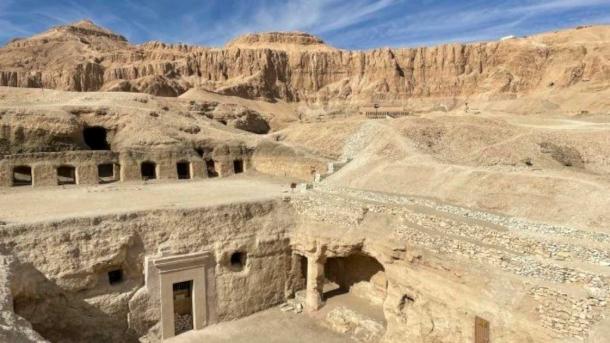
Archaeologists have restored the exterior of Amenhotep Huy’s tomb. ( Efe / Instituto de Estudios del Antiguo Egipto )
In fact, after the examination by the team of anthropologists, what can be gleaned is that these individuals are from the upper echelons of society. Specifically, they belong to family groups linked directly or indirectly to the medium-high clergy of Amun of Karnak (linked to the ginormous, world-famous Karnak temple complex in Luxor).
This is also seen in the items found in the vizier’s tomb, with a sarcophagus adorned with the god Amun, and are on display in an exhibition at the Luxor Museum, titled ‘Treasures of Minister Amenhotep Huy.’
The current archaeological mission is slated to resume at the end of September 2023, in more favorable weather conditions. The team also plans to restore the vizier’s chapel with the reconstruction of six columns in this interim.
Top image: The tomb of the Vizier Amenhotep-Huy in Luxor, Egypt. Source: Teresa Bedman / Institute of Ancient Egyptian Studies
By Sahir Pandey
[ad_2]
Source link